NMC Rules for MBBS Abroad: Important Things Students Must Check
Studying MBBS abroad can be a good option for Indian students, but choosing a university should not be based only on tuition fees, rankings, campus facilities or admission availability.
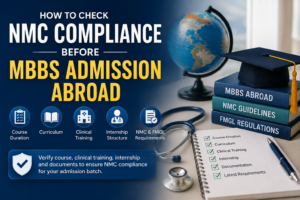
For students who plan to return to India and practise medicine, NMC requirements for Foreign Medical Graduates (FMGs) are extremely important. The National Medical Commission’s Foreign Medical Graduate Licentiate (FMGL) Regulations, 2021 specify important conditions related to the duration of medical education, medium of instruction, curriculum, clinical training, internship and registration requirements.
At MBBS-MD.com, we believe students should understand these requirements before paying fees or finalising a foreign medical university.
Why FMGL Compliance Matters
A foreign medical degree does not automatically mean that a student will be eligible to practise medicine in India.
Under the FMGL framework, students need to meet the applicable requirements for foreign medical education and later complete the required process for registration in India. NMC has also advised students to conduct proper due diligence before joining a foreign medical institution.
This means students should look beyond advertisements and ask for proper academic and clinical details from the university.
Important FMGL Requirements for MBBS Abroad
For students covered by the FMGL Regulations, 2021, some of the major requirements include:
- Minimum 54 months of medical education
- 12-month internship in the same foreign medical institution
- English as the medium of instruction
- Required medical subjects and appropriate theory, practical and clinical training
- Registration with the relevant medical regulatory authority in the country where the degree is awarded
- Required supervised internship in India after meeting the applicable conditions
- Passing the applicable licensing examination, such as the FMGE or another examination prescribed by NMC
These requirements are specified in the FMGL Regulations and related NMC FAQs.
1. Check the Total Course Duration
Before taking admission, ask the university for the official academic structure.
The FMGL Regulations specify a minimum 54-month duration for the foreign medical course. Students should therefore verify the actual teaching period rather than relying only on a university’s general statement that the programme is “6 years” or “5+1 years.”
Ask for:
- Official course duration
- Academic calendar
- Year-wise curriculum
- Semester-wise subjects
- Clinical training schedule
- Internship structure
2. Understand the Internship Properly
Internship is one of the most important areas to verify before admission.
For students covered by FMGL 2021, NMC specifies a minimum 12-month internship in the same foreign medical institution. The internship should therefore not be treated as just a certificate issued at the end of the course.
Students should ask the university:
- Where will the internship be conducted?
- How long is the internship?
- Is it conducted in the same institution?
- Which hospital is involved?
- What departments are included?
- Is attendance recorded?
- Are clinical rotations documented?
- Will official internship completion records be provided?
NMC’s FAQ also makes an important distinction between clinical training during the medical course and the internship completed after the course.
3. Review the Curriculum Before Admission
Do not select a medical university only after seeing its campus photographs or hospital videos.
The curriculum is one of the most important documents a student should examine.
The course should provide theory, practical and clinical training comparable with the required medical education standards. Students should obtain the official curriculum and check the subjects taught throughout the programme.
Before admission, ask for:
- Detailed syllabus
- Year-wise subjects
- Semester-wise subjects
- Clinical posting schedule
- Hospital training details
- Internship rotation plan
- Course catalogue or academic handbook
A university may have an attractive website, but the actual academic structure is what matters for your medical education.
4. Verify Clinical Training
Medical education cannot be evaluated only through classroom teaching.
Students should understand where their practical and clinical training will take place and whether adequate hands-on exposure is included.
NMC’s recent advisories specifically highlight clinical training, curriculum and internship arrangements as areas that students must verify before admission.
Ask for details about:
- Teaching hospitals
- Clinical departments
- Clinical postings
- Practical training
- Hospital affiliation
- Rotation schedules
- Attendance and training records
5. Check the Medium of Instruction
For FMGL 2021, the foreign medical degree must have English as the medium of instruction.
Students should confirm this directly with the university and understand how teaching is actually conducted.
Do not assume that a programme is compliant simply because its website says “English Medium.”
6. Verify the University’s Medical Regulatory Status
Another important point is the university’s status in its own country.
The FMGL Regulations require the graduate to be registered with the relevant professional regulatory body, or otherwise be eligible to obtain a licence to practise medicine in the country where the medical degree is awarded, under the applicable conditions.
Students should therefore ask:
- Which authority regulates the medical profession?
- Is the university authorised to conduct the medical programme?
- Is the qualification recognised in that country?
- Can graduates obtain the required local medical registration/licence?
- Which hospital is officially affiliated with the university?
7. Keep Your Academic Records Safely
Students should maintain complete academic documentation throughout their education.
Important records may include:
- Admission/enrolment documents
- Passport and visa records
- Academic transcripts
- Marksheets
- Degree or provisional degree
- Course completion documents
- Internship records
- Clinical training records
- Hospital-related documents
- Internship completion certificate
- Registration/licensing documents where applicable
Keeping these documents organised from the first year can make future verification much easier.
8. Physical Presence and Training Records Matter
Students should maintain proper records of their education and clinical training.
NMC has specifically warned students about foreign institutions and programmes that may not follow the required duration, curriculum or training standards. Recent NMC guidance also stresses that clinical training and internship arrangements should be carefully verified.
Therefore, students should keep their travel, academic and clinical records properly throughout the course.
9. Do Not Depend Only on an Internship Certificate
One common mistake is to ask only:
“Will the university provide an internship certificate?”
The better question is:
“What is the complete internship structure?”
Students should understand the duration, hospital, departments, rotations, attendance and supporting academic records.
A certificate is only one part of the documentation. The complete education and training record is much more important when assessing compliance.
10. Understand the Registration Process in India
After completing foreign medical education, students who intend to practise in India must follow the applicable regulatory process.
For FMGs covered by FMGL 2021, NMC’s FAQ states that students need to fulfil the prescribed foreign education requirements, pass the applicable examination, obtain the required provisional registration and complete the required supervised internship in India.
The exact process and examination requirements can change, so students should always check the latest information issued by NMC and the relevant authorities rather than relying on old information or verbal assurances.
What Should You Ask a Foreign Medical University Before Admission?
Before paying the admission fee, request official documents covering:
- Course duration
- Complete curriculum
- Medium of instruction
- Clinical training structure
- Teaching hospital details
- Internship duration and location
- Internship rotation plan
- Medical regulatory status
- Degree and transcript format
- Registration/licensing pathway in the country of study
NMC itself advises students to obtain details of the course, including its content, duration and internship, directly from the foreign institution before admission.
A Simple Rule for Students
Do not choose an MBBS abroad university only because the fees are low.
Before making a decision, compare the university’s:
Course + Curriculum + Clinical Training + Internship + Recognition + Documentation
A lower fee is not useful if the programme does not provide the academic and clinical structure required for your future plans.